Why Trump Is Floundering in the Polls

On this blog, I discuss important national issues, often centering on fiscal and economic matters.  Often this involves discussing presidential policies, successes, and failures.

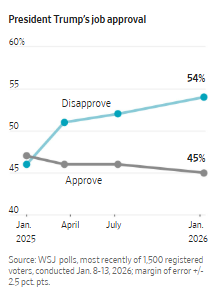
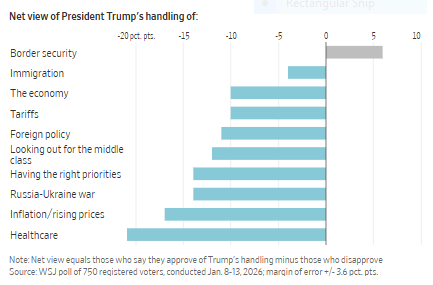
Today I discuss the question of why Trump’s approval ratings have recently been declining, see here and here. Clearly, he is in trouble with the electorate.

Consider:

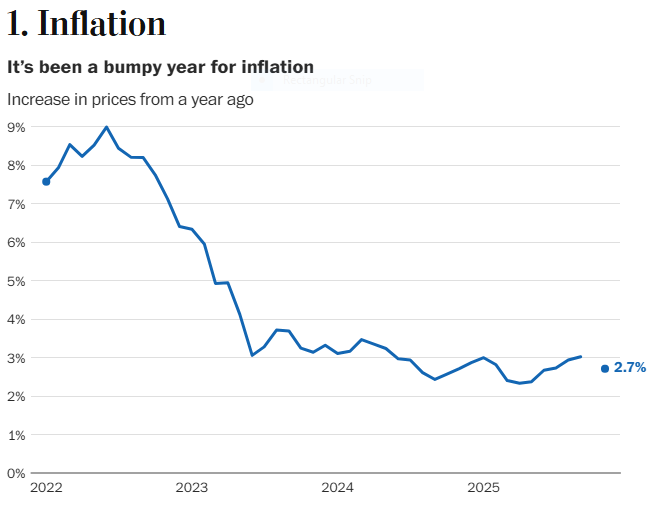
  • Inflation. The latest CPI (Consumer Price Index) rating is 3% for September 2025, too high for comfort.  The Federal Reserve’s credible goal is a CPI rating of 2%, and we’re not there yet.
  • Affordability.  (this refers to the cumulative rise in CPI since before the pandemic). This measure of inflation is about 25%, which means that things in general cost 25% more than they did before the pandemic began in 2020.  Of course, most of this increase occurred under President Biden, but we’re now on Trump’s watch, and people who are feeling pain over consumer costs, will naturally blame the current president.
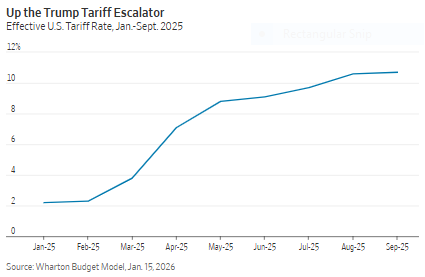
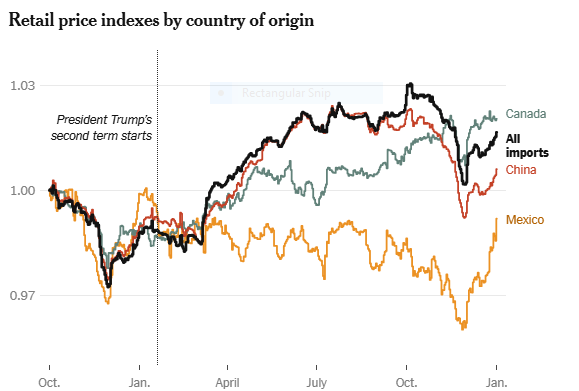
  • Tariffs. Trump says that since other countries put tariffs on our exports, then it is only fair for us to put tariffs on theirs.  The problem with this thinking is that tariffs on our imports increase their costs to American consumers, i.e., are inflationary. This is what consumers have to deal with on a day-to-day basis, not abstract arguments about fairness.
  • Lowering healthcare costs. Healthcare costs are much too expensive overall, and this is part of the affordability problem.  Republicans need to address this issue with, for example, a plan for individual health savings accounts.  President Trump could help by publicly supporting action on this issue.
  • Our Southern Border. Biden made a huge mistake by opening our border with Mexico to large numbers of undocumented immigrants.  But now Trump has overreacted by deporting large numbers of even long-time illegals, including those who are law-abiding and holding down low-paying jobs vital to our economy.  Furthermore, ICE (Immigration and Customs Enforcement) is often perceived as denying due process to those who are rounded up for deportation.
  • Unattractive subordinates in important positions. People like Pete Hegseth (Secretary of Defense), RFK,Jr (Secretary of Health and Human Services), and Steve Witkoff (Roving Ambassador) often make public statements that appear to be uninformed and/or misguided.

Conclusion.  In order to head off Republican electoral disaster in the 2026 midterm elections, now less than a year away, President Trump especially needs to do a better job of focusing on core economic issues, especially those dealing with people’s pocketbooks, such as inflation and affordability.

Follow me on Twitter 
Follow me on Facebook 

Increasing Income Mobility in America

On this blog, I address major national issues, especially on fiscal and economic matters.  This often involves discussing congressional and presidential policies, both successes and failures.

Last week, I discussed how to achieve economic success in America.  This week, I extend that discussion by talking about what is involved in achieving income mobility, i.e. by moving up the income ladder.  Consider:

  • First of all, the essentials for economic success are a good educational background and, also, acquiring some useful skills, either vocational or academic.
  • For income mobility, what is needed is both human capital (having adults that children can count on) as well as the opportunity to get a good education.
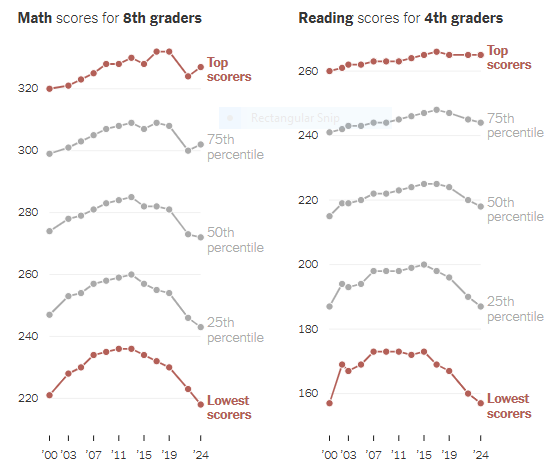
  • The problem in the U.S. is that K-12 educational performance has been deteriorating since about 2013, well before the beginning of the pandemic. See here, and here.
  • Unfortunately, educational reform is often not really occurring in the U.S. The best way to improve K-12 education, school choice, is flourishing in the red states and failing in the blue states.  Public education is doing especially poorly in serving low-income kids in the inner city. This means that the Democratic Party is, in effect, increasing educational inequality between the middle class and the lower middle class. Obviously, this sets back income mobility amongst the poor, where it is most needed.

Conclusion.  The opportunity for everyone to achieve economic success in America is one of the great strengths of our country.  Income mobility, moving up the income ladder, is harder for kids who start at or near the bottom.  Human capital is often the luck of the draw, but educational resources, provided by the state, can be improved by enlightened public policy.

Follow me on Twitter 
Follow me on Facebook 

Becoming Economically Successful in America

On this blog, I discuss important national issues, especially on fiscal and economic matters.  Often this involves discussing policies of Congress or the President, for example, where President Trump is succeeding or not succeeding.

Today, I discuss what every (especially) young person should do to get off to a good start in life.  Consider:

  • When opportunity knocks, we need to be prepared to open the door. Everyone is likely to have a good job opportunity at one time or another.  Be well prepared when this happens.

  • Graduate from high school, get a job, and don’t have kids before marriage. This is just ordinary common sense that everyone should try to follow.
  • Acquire a useful nontrivial skill. This could mean taking a vocational course in high school or perhaps going to a Community College to study a trade.  It could also mean taking a job as an apprentice to a skilled craftsman.
  • Consider going to a four-year college if you have adequate academic skills. Only 27% of the workforce today is in blue-collar jobs.  By 2031, 42% of jobs will require a BA or a BS degree, up from 35% today.   If you do go to college, be sure to choose a useful major, of which there are many.  STEM majors (Science, Technology, Engineering, Mathematics) are very useful, as are Business majors, and, of course, Education majors for future teachers.  All healthcare professions pay well.
  • Many colleges and universities are not expensive, and scholarships are often available. If cost is still a big factor, start out by taking academic courses at a community college and then transferring to an in-state public university.
  • When you finish school, at whatever level, look around for enlightened employers. For example, more than 12,000 U.S. companies, currently share ownership with more than 25 million employees. Many of these employees have become millionaires in the process.

Conclusion.  There are many different ways to make a good living.   Start out by getting a good education in an area that gives you useful skills in a field that you enjoy.  Then look for an enlightened employer who values its employees.  Work hard at your job, and you will be off and running to a successful career!

Follow me on Twitter 
Follow me on Facebook 

My Conservative Political Views

On this blog, I discuss important national issues often on fiscal and economic matters.  Of course, this includes talking about how the President is doing, from time to time.

Today, I discuss my own views on what I consider to be our country’s biggest and most urgent problems.  I do this occasionally to show where I am coming from when I talk about what we should be doing on particular issues.

Consider:

  • The U.S. is the strongest and wealthiest country in the world. The reason for this success is our free market economic system and our brilliant system of government, a constitutional republic.  Thus, we have both strong democracy and economic opportunity as well as natural advantages, such as bicoastal geography and friendly neighbors, both north and south.  We also enjoy more personal freedom than most other countries.
  • Except for the Civil War, necessary to abolish slavery, we have historically been able to resolve our differences peacefully. I expect this peaceful tradition to continue, even given the current political polarization between the two major parties.
  • Our biggest national problem is our out-of-control national debt, especially our annual deficit spending, now nearly $2 trillion ( $1.84 trillion in FY 2024 and $1.78 trillion in FY 2025, just completed).  To fix this very serious problem, we need to cut annual federal spending, now over $7 trillion per year, by at least $1 trillion.  This cannot be done without reforming entitlement programs such as Social Security and Medicare to make them less expensive to the federal government.  Unfortunately, President Trump is not sufficiently serious about our debt problem.
  • We have several autocratic adversaries such as China, Russia, Iran, and North Korea, with whom we are competing for global influence. China is by far our strongest rival.  But China has major economic problems of its own (an overdependence on exports), and is unlikely to challenge us militarily.  The recent trade agreement between Presidents Xi and Trump is likely to keep our competition peaceful for the time being.
  • It is vitally important for the U.S. to maintain a strong military presence around the world to ward off problems when they arise. In this respect, working with our many democratic allies around the world is critical for our own national security.  Except for some excessive tariffs on allies, President Trump is doing a good job in this respect.
  • Is our democracy in danger?   No, democracy is thriving in the U.S.  President Trump is certainly pushing the limits of presidential authority, but, with one minor exception, he is abiding by judicial rulings.  The Democrats simply need to become more moderate to do better in national elections.

Conclusion.  The U.S. is a strong country both economically and militarily.  We also have the huge benefit of much individual freedom.  But our national debt is a huge and growing problem.  We should cut federal spending by at least $1 trillion per year, to reduce our annual spending deficits to a more reasonable level.  Unfortunately, given our current political polarization, it might take a new fiscal crisis to get this done.

Follow me on Twitter 
Follow me on Facebook

The Right Way and the Wrong Way to Address Poverty

On this blog, I discuss important national issues, often connected with fiscal and economic policy.  Lately, I have spent a lot of time discussing the policies, pro and con, of President Donald Trump.

My last post discussed the possibility of a wealth tax, as opposed to an income tax, and why that is not a good idea.  Today, I discuss a related issue, how to address poverty in the United States.

Consider:

  • The definition of poverty. In 2024 the official poverty rate in the U.S. was 10.6% for a total of 35.9 million people. For example, the poverty threshold for a family of four (two adults, two children) was $31,200.  For a single individual, it was $15,060.
  • How can poverty be reduced? The customary advice for anyone to avoid poverty is to 1) graduate from high school, 2) get and hold a full-time job, and 3) don’t have children before getting married.  What society in general can do to reduce poverty is to provide a strong educational system at all levels, ensure access to affordable and basic healthcare, and create a dynamic economic system to make sure that there are well-paying jobs at different income levels.
  • Ameliorating the poverty that does exist. While attempting to move people up the income scale, society should also try to lessen its negative effects on the poverty that does exist.  This can be done with temporary assistance for needy families (TANF), food stamps (SNAP), temporary housing vouchers, and additional income for working adults (EITC).
  • What won’t help: reducing inequality between different income groups. It is a simple fact of life that real median incomes for different groups won’t grow at the same rates over any extended period of time. This is clearly evident in the attached chart.  In this chart, the lowest several income groups have grown much more slowly than the highest income group. This does not contribute to the poverty that exists in the lowest group. Society should try to raise up the people on the bottom, rather than trying to reduce incomes for people higher up on the income ladder.

Conclusion.  Society should take all reasonable steps to reduce the national poverty rate as well as ameliorate the effects of poverty on those who are unfortunate enough to be poor.  But attempting to reduce income (or wealth) inequality amongst the general population, is not only a bad idea in general, it won’t help one bit to reduce the overall poverty level.

Follow me on Twitter 
Follow me on Facebook 

Taxing Wealth, in Addition to Income, Is Not a Good Idea

On this blog, I discuss important national issues, especially fiscal and economic matters.  Lately, I have been especially comparing the strengths and weaknesses of the Trump and Biden agendas.

Today, I will discuss the idea of taxing wealth, in addition to income.  Senator Bernie Sanders of Vermont supports doing this.  I have no intrinsic opposition to making the ultra-wealthy pay higher taxes.  Billionaires, for example, could easily afford a 1% or 2% annual tax on their great wealth.  The problem, in my view, is the difficulty of implementing a wealth tax.  Consider:

  • Firstly, how is wealth defined? If wealth consists solely of stock market holdings, then it could, for example, be measured by stock market values on the last day of the year.  But how about financial holdings not invested in the stock market, such as in private companies?  Or wealth held by ownership of real estate, or even in art collections?  Establishing a fair evaluation of such forms of wealth would be highly subjective and subject to extensive litigation.  And the existence of a wealth tax would encourage the very wealthy to attempt to hide their wealth in tax shelters, which are already a problem even without a wealth tax.

  • Secondly, a wealth tax would be unconstitutional. The Sixteenth Amendment to the Constitution authorizes the taxing of income, “from whatever source derived,” which does not include wealth itself.  Of course, the Constitution could be amended to authorize the taxing of wealth.  But this requires the votes of two-thirds of both the House and the Senate, unlikely in our closely divided Congress, when most Republicans would surely be in opposition.  And, even in the unlikely event that such an Amendment were proposed by Congress, it is unlikely to be ratified by three-fourths (38) of the states.  As I have previously discussed, 25 states have effective trifecta control (both legislative branches and the governorship) by the Republicans and only 15 by the Democrats.  Again, this means that it would be virtually impossible for a Constitutional Amendment taxing wealth to be ratified by the required 38 states.

  • Thirdly, our annual spending deficits are running at about $2 trillion and must be greatly reduced.  But this can and should be done primarily by cutting federal spending.  Annual spending was about $5 trillion a year before COVID and has now ballooned to over $7 trillion.  Taking recent inflation into account, it needs to be cut back to the vicinity of $6 trillion.  Debt is the big problem, not inequality.

Conclusion.   I have no intrinsic problem with making the wealthy pay greater taxes, but a direct tax on wealth, as opposed to income, will not work.   Firstly, it is inherently difficult to measure wealth in an objective manner.  Secondly, a wealth tax would be unconstitutional.   Thirdly, our real problem is debt, not inequality.

Follow me on Twitter 
Follow me on Facebook 

We Need to Calm Down Our Political Rhetoric

On this blog, I discuss important national issues, often dealing with economic and fiscal matters.  With the murder of Charlie Kirk, conservative leader of Turning Point U.S.A., several days ago, I change my tone today.

Mr. Kirk was the embodiment of civil discourse.  He wanted to debate issues, not defame his political adversaries.  How should we all as individuals respond to this tragedy?

  • Clearly, we should try to follow the example that Charlie has set. We should continue to express our views as clearly and forcefully as we can, but without disparaging either the motives or the character of those who disagree with us.

As President, Donald Trump could also try to set a more civil tone of political discourse and behavior.  For example, he could:

  • Tone down the rhetoric and implementation of tariffs, especially on our democratic allies around the world. This would remove much of the uncertainty that is currently disrupting the economy and making inflation worse than it would be otherwise.
  • Cut back on ICE enforcement raids on critical industries. The raid on the South Korean Hyundai Battery Plant in Georgia was especially harmful, considering that the Administration is trying to work out a big trade agreement with South Korea.

  • Shift attention from tariff and immigration issues to foreign policy issues such as the Israel/Gaza and Russia/Ukraine situations, which would benefit from strong and decisive US intervention, see here and here.

Conclusion.  Let’s honor Charlie Kirk’s memory by attempting to make his murder a real turning point in American political discourse.  Everyone, from political leaders to ordinary American citizens, can contribute to making this a reality by toning down our own rhetoric.

Follow me on Twitter 
Follow me on Facebook 

Where Trump Is Succeeding and Where He Is Not Succeeding

On this blog, I discuss important national issues, often with reference to economic and fiscal matters.  Lately, I have devoted much attention to presidential politics, especially concerning the records of Presidents Biden and Trump.

Today, I discuss where I think President Trump is both succeeding and not, first, where he is succeeding:

  • Populism is popular. Not surprisingly, mass, uncontrolled, migration is very unpopular all over the Western world.  Trump has essentially closed our southern border to illegal crossings.

    Furthermore, (mostly illegal) immigrant population has declined by about 1.4 million  since January 2025, showing the effect of Trump’s policies (see chart below).

    Public K-12 education is performing poorly in the inner city, and Democrats have virtually given up on school reform.  It is in the red states where school choice is prevailing.

  • Wokeness prevails in the blue states. Notions of white supremacy, systemic racism, and gender fluidity, for example, are very unpopular amongst the non-elite.
  • Crime control. His National Guard intervention in Washington, D.C. is popular and working well, but his power to intervene elsewhere is limited by law.

But President Trump is also floundering in some areas, especially on the economy:

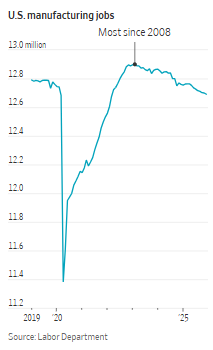
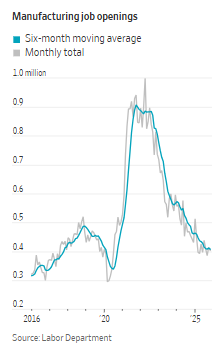
  • Labor market gains have slowed to a crawl, as demonstrated in the chart below. The problem is the uncertainty being caused by constantly changing tariff policies, which override the gains from the recently passed business tax reforms. The middle-class vibe has changed from secure to squeezed.

Conclusion.  Trump is riding the reigning populist, anti-woke wave, so prominent in the affluent Western world.  But inflation is still pronounced, and his constantly changing tariff policies are creating economic uncertainty.  His political fate is up in the air at this point.  It will be tested in the 2026 midterm elections.

Follow me on Twitter 
Follow me on Facebook 

The Effect of Political Polarization on U.S. Government.

On this blog, I discuss a variety of important national problems, often centered around fiscal and economic issues.  Today, I talk about political polarization, which is considered a major issue by many people.

State level polarization. We know that our national politics is highly polarized between the two parties.  It so happens that politics at the state level is also highly polarized.  Looking at the map below, one can see that 25 states are completely controlled by Republicans, either by holding both legislative branches and the governorship, or else both legislative branches with supermajorities, with 15 states being controlled by Democrats in the same way. This means that issues like abortion and gun control can be dealt with on a completely partisan basis by one party alone in 40 out of 50 states.

School choice.  School choice is booming in the red states.  In Florida, for example, 51% of K-12 students are now attending a school of their choice, beyond the neighborhood school they are assigned to.  School choice in the U.S. is the tipping edge of much-needed education reform. 

Congressional redistricting. Congressional redistricting is required every 10 years after a new census in order to equalize population between districts. This process is controlled by state legislatures.   But occasionally, such as at the present time, some states will try to redistrict mid-census. Republican Texas and Democratic California and Illinois are considering this right now.

But regardless of how this plays out, the chart below shows that, based on current population trends,  Democratic states are likely to lose 12 Congressional seats after the 2030 census, with Republican states gaining 12 seats.  This will be a big blow to Democratic prospects for control of the U.S. House of Representatives.  The more one party dominates Congress, the more powerful polarization becomes.

Conclusion.  Both our national government and our state governments are highly polarized at present and are likely to become more so in the near future.  There is at least one benefit of state-level polarization.  It is allowing red states to establish school choice.  This is the tipping edge of education reform.  As school choice improves K-12 educational outcomes, as it surely will, hopefully blue states will recognize this and get on board.

Follow me on Twitter: https://twitter.com/jack_heidel
Follow me on Facebook: https://www.facebook.com/jack.heidel.3

The American Dream Is Alive and Well

On this blog, I discuss important national issues of many different types. types.  Lately, the discussion has mostly been about the successes and failures of Presidents Biden and Trump. See here and here.

But let’s step back from day-to-day politics and take a look more generally at how well America is doing.  Several years ago, I summarized a study by the American Enterprise Institute’s Michael Strain on how well the American middle class is doing.  The main findings were: 1) wages for typical workers have increased by at least 20% in recent decades, 2) the median household has seen net income, after taxes and income transfers, grow by 44% in recent years, and 3) the share of adult children with higher incomes than their parents is very high.

Now consider a recent update by the AEI’s James Pethokoukis:

  • As of today, real wages for the median worker have increased by 40% since the business cycle peak of 1990. And this doesn’t take into account the modern consumer innovations such as smartphones, ride-sharing, and targeted cancer immunotherapy.
  • The age-adjusted cancer mortality rate has fallen dramatically in the past thirty years. It is now one-third less than in 1990.  In the U.S. alone, more than six million deaths were averted between 1975 and 2020 from just five forms of cancer: lung, breast, bowel, prostate, and cervical.
  • And there is more ahead. Research into pre-cancer biology, immunotherapies, and risk-targeted vaccines is moving fast. Thirty years from now, cancer will be much less deadly than it is today.

Conclusion.  The big story here is progress: economic, technological, and medical.  This stands in sharp contrast with the prevailing declinist narrative that dominates so much of our present-day politics.

For my Email Newsletter
Follow me on Facebook
Follow me on Twitter